Guide
What is SynthID?
SynthID is a family of watermarking technologies from Google DeepMind. It writes a signal into the pixels of an image, the frames of a video, the waveform of an audio clip, or the word choices of a text, so a file can be identified as machine-made without carrying a visible badge. Once the mark is in a file, it stays: there is no switch to turn it off, and detectors can still read it after cropping or re-encoding.
Last updated 11 November 2026
Who makes SynthID?
Google SynthID is built and maintained by Google DeepMind, which published the SynthID-Text method in Nature in October 2024. Google applies it across its own image, video, audio and text models.
Google reports the reach of the system over time. As of May 2025, Google reported that SynthID had watermarked 10 billion pieces of content. By May 2026, Google reported 100 billion images and videos, plus the equivalent of 60,000 years of audio. In an October 2026 update, Google reported 180 billion images and videos, plus 240,000 years of audio.
Google launched the SynthID Detector portal for early testers in May 2025 and opened it to everyone worldwide in October 2026.
Check and remove SynthID from your images
The detector reads an image and reports a confidence score; the remover re-synthesizes the pixels to reduce how strongly the mark reads. Start for free. New accounts get 100 credits. You only spend them when you run a job.
How does SynthID work?
SynthID embeds a signal while a model generates the content, and a detector reads it back from the finished file.
- The model embeds the watermark as it creates the content, so the signal is written while the pixels, frames, waveform or words are generated.
- The signal is spread across the whole output and tuned to stay below the level a person can see or hear.
- It is built to survive the edits people make: cropping, compression, resizing and screenshots.
- A detector reads statistical patterns in the file and estimates whether the signal is present.
- The detector reports a confidence level, so a result is a probability.
Where SynthID is used
Google applies the SynthID watermark across four content types and embeds it at generation time. The public portal reads the mark in images, video and audio.
SynthID compared with metadata labels
SynthID and metadata labels such as C2PA credentials, EXIF tags and IPTC disclosures both record that content is AI-generated. They behave differently once a file is edited or shared.
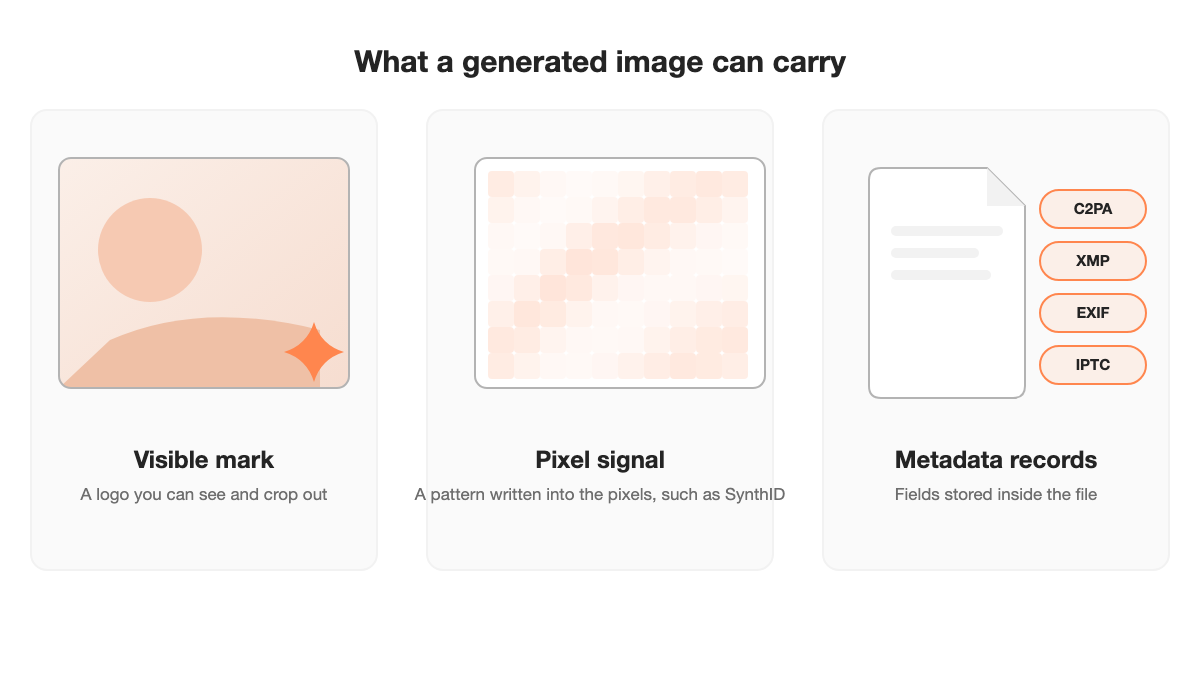
If the metadata side is what needs to go, the C2PA remover strips content credentials and the metadata remover clears EXIF and IPTC fields.
How durable is the SynthID watermark?
The signal is built to survive what people do to content. It is spread across the whole frame rather than stored in one spot, so cropping, re-compression and noise filters damage the picture while leaving the mark readable.
We verified this against Google’s own detector. In our tests, stripping the metadata, resampling the image to 1024 pixels, adding noise and re-encoding at JPEG quality 82 all left the mark readable. Only re-synthesizing the image cleared it.
That rewrite is what the SynthID remover does, and the result should be read as a reduced signal rather than a guarantee.
The mark has no off switch, either. Google lets you turn the visible watermark off in Gemini; the invisible one stays on free and paid plans alike. A missing mark never proves that a file is human-made.
What SynthID means for your images
When a file carries SynthID and you need a clean copy, the mark has to be rewritten out of the pixels, because that is where it lives. SynthIDX re-synthesizes the image to reduce how strongly the signal reads. It cannot promise a complete removal.
Run the result through the SynthID detector before you rely on it, and keep the report with the file.
Gemini and Nano Banana images carry both a visible logo and the invisible signal, so the Gemini watermark remover explains how the two layers differ and when each job applies.
If you want to compare the options first, the full tool list groups every remover and detector by task.
A detector result is a probability. A lower reading does not mean that no detector anywhere will flag the file again.
Frequently asked questions
- What is the SynthID paper?
- The SynthID paper is Google DeepMind's write-up of the SynthID-Text watermarking method. It appeared in Nature in October 2024 and covers how the signal is embedded and detected.
- Who made SynthID?
- Google DeepMind made SynthID. The team builds and maintains it, and Google applies it across its image, video, audio and text models.
- What is SynthID in Gemini?
- In Gemini, SynthID is the mark Google applies automatically to everything the model generates: images, video, audio and text. Gemini images also carry a separate visible watermark, which is a different layer from the invisible SynthID signal. You can upload a file to Gemini and ask whether it was made with Google AI.
- How does SynthID work?
- SynthID embeds a signal while a model generates the content, and a detector reads statistical patterns in the file to estimate whether the signal is present.
- Is SynthID visible?
- No. The signal is designed to be imperceptible, so a marked image looks the same as an unmarked one.
- What does SynthID look like?
- In the file itself, nothing: the signal carries no visual pattern you could crop out or point at. What people see is the separate visible logo on some Gemini images. A detector reports a confidence score, and Google's Detector portal also shows which regions of a file are most likely watermarked.
- Can SynthID be removed?
- The signal lives in the pixels, so removing it means rewriting them. SynthIDX re-synthesizes the image to reduce how strongly the mark reads. The result is a probability.
- Does every AI image have a SynthID mark?
- No. Google's own models apply it at generation time, and partner platforms such as OpenAI, NVIDIA and Kakao have joined the SynthID ecosystem. Claude, Grok and most open-weight models still carry no SynthID mark.
- How do you use SynthID?
- On the creation side there is nothing to set up: Google's models apply the mark as they generate, and there is no switch to turn it off. On the verification side you check a file with the SynthID Detector portal, open to everyone worldwide since October 2026, or with an independent image detector.
- What is the difference between SynthID and C2PA?
- SynthID is a watermark inside the content, while C2PA is a set of metadata credentials that travel with the file. A file can carry both, and either one can be present on its own.